
What is paving stone jointing? In the paving stone laying process, the pieces alone are not enough to constitute a beautiful and safe pavement or path. Therefore, it is essential to follow all the appropriate steps in the laying process, including, and very importantly, paving stone jointing.
Steps to lay paving stones
The steps to be taken are as follows:
- Evaluation of materials.
- Development of the transverse slope.
- Delimitation of the perimeter confinement.
- Creation of the base layer.
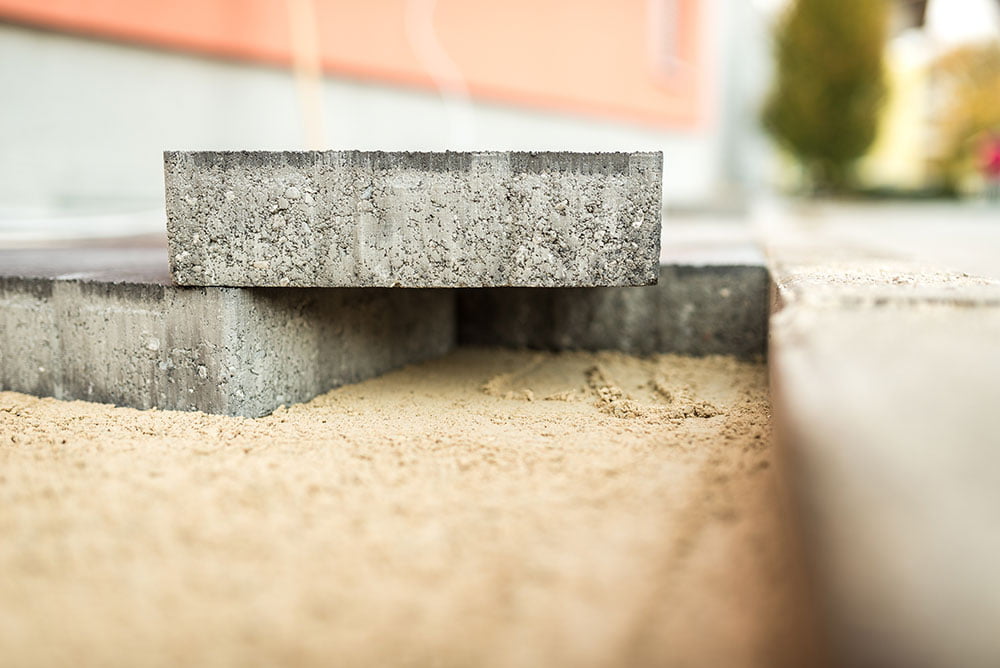
- Development of the bedding layer.
- Mixing of the paving stones.
- Installation.
- Jointing.
- Vibration
- Cleaning
How is the surface prepared before paving stone jointing?
It is essential to highlight the importance of selecting and preparing the surface adequately before starting the installation process. This preparation is crucial to ensure the durability and aesthetics of the finished pavement.
Once the appropriate type of jointing has been selected for the project, whether with clean sand, synthetic resin grout or waterproof mortar, the next step is to prepare the surface. This preparation includes ensuring that the base on which the paving stones will be laid is level, compact and free of any material that may prevent adequate adhesion or settling of the paving stones and the paving stone jointing material.
To do this, any vegetation, debris or loose material must be removed. Subsequently, it is advisable to apply a layer of geotextile material over the natural ground, followed by the laying of a base layer of compacted gravel. This base layer not only provides firm support for the paving stones, but also facilitates water drainage, thus preventing the accumulation of moisture under the pavement.
Compaction of the base
It is important to note that the base compaction process must be carried out meticulously, using appropriate equipment to ensure a uniform and resistant surface. Once the base is prepared, the paving stones are installed following the chosen design pattern. During this process, it is vital to maintain precise alignment and ensure that each paving stone is level with respect to the others.
Finally, after laying the paving stones and paving stone jointing, it is advisable to apply a specific sealant for paving stone pavements. This sealant helps protect the surface against stains, wear and tear and the proliferation of weeds, as well as enhancing the color and texture of the paving stones.
In conclusion, the correct installation and jointing of paving stones not only depends on following the appropriate steps and using the correct materials, but also on a meticulous preparation of the surface and the application of final protective treatments. These practices ensure the creation of aesthetically pleasing, durable and safe pavements and paths.
How is paving stone jointing done correctly?
Traditionally, products based on hot pitch or manual compounds with sand or cementitious mortars are usually used for jointing. These works present latent drawbacks, since they are slow and costly processes, in which the surface is often stained.
In addition, since these products are usually impermeable to water and air, there is a danger of rapid loss of sand caused by rain erosion, wind or cleaning machinery. The loss of this sand contributes to the destabilization of the pavement and the free growth of weeds.
To carry out correct jointing, clean sand should preferably be applied, which does not contain clays. The jointing material must be carefully integrated into the joints using a broom. Sometimes, it should be reapplied once the sand settles to ensure greater stability. It is necessary that it is a material stable to filtration towards the bed and that it also has the appropriate particle size to the width of the joint. In no case shall the aggregate of a larger thickness be greater than the width of the joint. In the joints, it is necessary to introduce rock flour, sand and quartz sand. It is essential to fill to the edge of the joint itself.
Types of jointing
The following are two types of paving stone jointing: jointing with synthetic resin grout and waterproof mortar in pavement joints.
To carry out jointing with synthetic resin grout, the surface of the stone must be completely moistened with the water hose. Subsequently, the mortar must be distributed and pressed onto the individual cracks using a rubber squeegee. The joint must be at least 30 millimeters deep, while the width must be at least five millimeters. The mortar will have to set for 20 minutes; subsequently, it is necessary to brush off the excess material with a broom. At this point, it is advisable to pay attention so that no residue penetrates into the still open joints. The worked surface must be protected from moisture for a minimum of twelve hours.
As for the waterproof mortar in pavement joints, paving stones that constitute a slope must be placed and drainage must be implemented with the waterproof grout. This is an identical process to the one that is permeable to water. It is essential to take into account that the waterproof mortar must be rinsed with water instead of cleaning it with a broom. When the waterproof grout is used, the slope of the surface must be pronounced in order to favor the drainage of rainwater; in turn, drainage is also necessary in the final area of the paved surface.
Cleannox, concrete professionals
At Cleannox we have a wide range of decorative products for pavements that have great resistance, as they have been manufactured under extreme pressure, implementing high frequency vibrations. We offer a wide variety of designs, textures and colors that will satisfy the needs of our customers. We work for different points of Castilla-La Mancha and paving stones for Madrid. In addition to other points of the peninsula such as Palencia, Valladolid, Zamora, Soria, Santander or Asturias. Thanks to our logistical capacity we can reach other regions. Ask about our services. We will be happy to give a new life to the pavement with photocatalytic and sustainable properties.

Cleannox, adoquines de hormigón para pavimentos decorativos. Adoquines ecológicos con efecto fotocatalítico.