

In recent years, the use of semiconductor construction materials based on the photocatalysis process has experienced rapid growth. Its success lies in its great effectiveness as a decontaminating agent. They contribute to reducing the concentrations of toxic elements in cities. In addition, they have antibacterial, antimicrobial and thermoregulatory properties.
At Cleannox we are aware of this, which is why from January 1, 2023 all our production of concrete paving stones is manufactured with a photocatalytic and decontaminating effect with which we contribute to the destruction of nitrogen dioxides, among other benefits.

Our ecological paving stones: Cleannox
Cleannox is the brand under which all our production of ecological paving stones with a photocatalytic effect is manufactured with the aim of reducing the maximum values of lead, sulfur dioxide, nitrogen dioxide, in the ambient air set in accordance with European regulations.
It must be taken into account that low levels of nitrogen oxides in the air can cause negative health consequences such as lung, throat, nose problems, eye irritation, asthma, etc.
The objective of Cleannox paving stones is, thanks to their sustainable and innovative properties, to take care of urban spaces and reduce the pollution present in them to guarantee greater health for people.
At Cleannox, we make all our pavements based on the test methods marked in the UNE 127197-1:2013 standard to evaluate the performance of our photocatalytic concrete paving stones and slabs.
What does photocatalysis consist of?
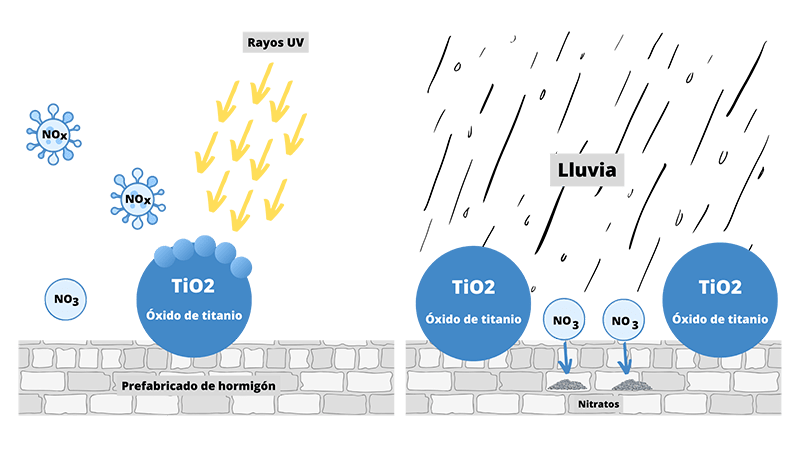
Photocatalysis is a process based on photosynthesis. It is a natural decontamination process. In nature, photosynthesis has the ability to eliminate CO2 and create organic material. Through photocatalysis, polluting elements present in the atmosphere can be eliminated; solar energy is used to activate the oxidation and destruction of these pollutants.
To cause this photochemical reaction, we use semiconductor materials that act as catalysts and accelerate the process of eliminating polluting elements generated by industry, energy production or vehicles.
Sunlight or artificial UV light impinges with a wavelength of ˂385 nm on the substrate. This causes the nanometric crystals of TiO2 to react with the humidity of the atmosphere. The chemical reaction promotes the release of the OH radical, which stands out for its high oxidative power. The radicals react with harmful environmental elements and convert them into NO3, stable and non-harmful compounds.
Photocatalysis and decontaminating materials
Photocatalytic processes have demonstrated high efficiency for the elimination of most of the polluting agents present in urban areas: nitrogen and sulfur oxides (NOx and SOx), carbon monoxide (CO), ammonia (NH3), volatile organic compounds (VOCs), methyl mercaptan, polyaromatic compounds and pesticides, among others. In addition, they facilitate the elimination of fungi, bacteria and viruses.
This explains the accelerated expansion of the use of decontaminating construction materials that facilitate the photocatalytic process. Cement, for example, is the ideal medium for its diffusion, by mixing with titanium dioxide.
Advantages of decontaminating materials
Photocatalytic materials have demonstrated high effectiveness as decontaminating agents. In addition, they are economically efficient materials. We will detail its main advantages:
- They reduce the concentration of urban polluting elements, such as carbon oxides produced by traffic.
- If we use them in the pavement, they prevent overheating of the surface, which helps to reduce the heating of cities.
- They significantly reduce cleaning and maintenance costs, as they have a high self-cleaning capacity. This is because photocatalytic components do not allow dirt to accumulate on surfaces. In addition, they eliminate bad odors thanks to their antibacterial properties.
- They are durable materials. Thanks to their antimicrobial properties, they do not promote the proliferation of fungi and bacteria on their surface.
Decontaminating concrete paving stone pavements
The use of paving stones with photocatalytic properties favors the eradication of highly contaminated environments in cities. An example is Cleannox eco paving stones. These are capable of neutralizing up to 90% of the polluting gases produced by traffic (for example, benzene and nitrogen oxides). They also prevent the formation of acid rain, which causes serious damage to forests, and combat the heating of the surface and, therefore, of cities.
These paving stones offer the same durability as conventional ones, but maintain the photocatalytic effects throughout their life. Even, certain studies indicate that this type of paving stones have greater resistance to the segregation of the cement paste and a better filling between its grains. They do not suffer any wear due to chemical reactions.
Cleannox is a company registered in the Iberian Association of Photocatalysis. We are committed to preserving the environment. We make available to customers our production of precast concrete with Cleannox photocatalytic effects. We make your environment breathe. Trust our paving stones.

Cleannox, adoquines de hormigón para pavimentos decorativos. Adoquines ecológicos con efecto fotocatalítico.